Risk Management in Trading and Investing: Playing the Right Game in the Right Timeframe!

Risk management is not about avoiding losses. It is about choosing which risks to take, when to take them, and in what size, so that you survive long enough for compounding and any true edge to work in your favor.
Most people think in terms of “what to buy.” Robust risk management starts one step earlier: “over what timeframe am I willing to hold this and watch it move against me?”
1. Everything Starts With Timeframe
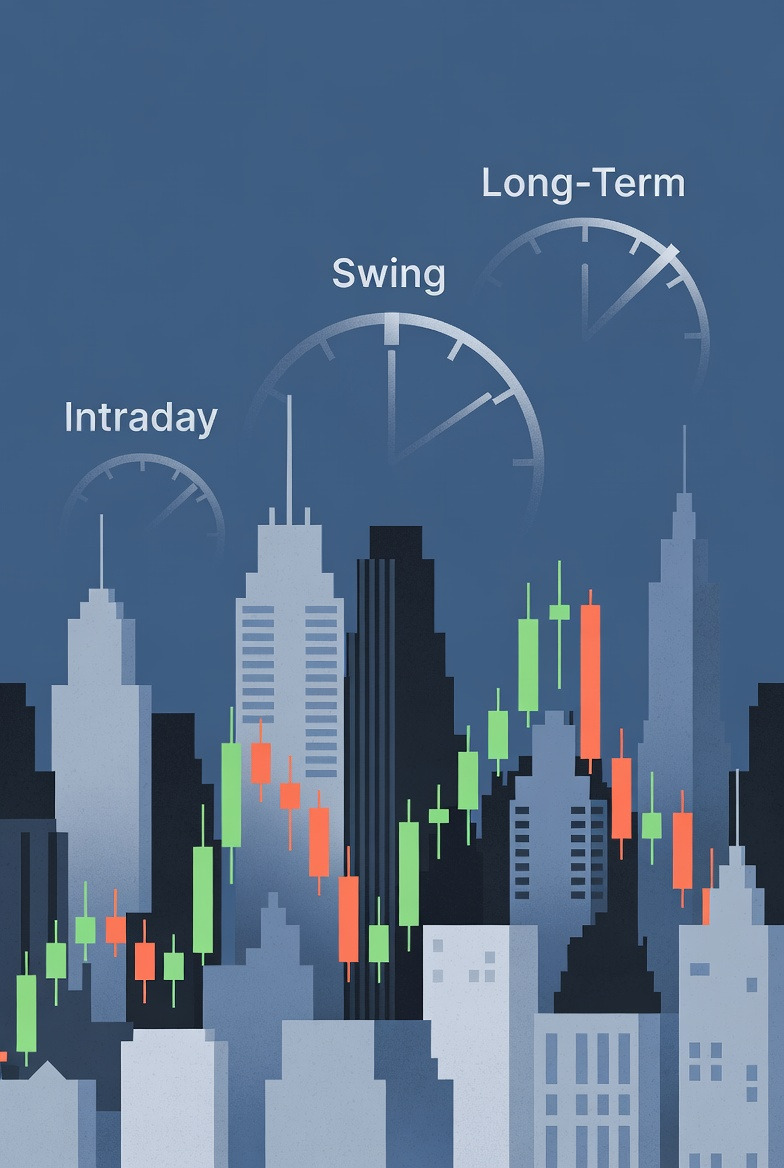
Before talking about entries, exits, or allocation, define your timeframe. At minimum, separate your activity into three buckets:
Intraday (minutes to one day)P&L is driven by order flow, liquidity, microstructure, and very fast information. Positions are opened and closed within the same session.
Swing / Positional (days to a few months)P&L is driven by short‑term cycles: earnings, news, sentiment, sector flows, and technical structures.
Investment (years to decades)P&L is driven by business fundamentals, credit and economic cycles, and long‑term policy and liquidity regimes.

Risk management differs sharply across these buckets:
Intraday: the main risks are position size vs intraday volatility vs slippage and costs. Edges are typically small, and competition is intense.
Swing: the key risks are overnight gaps, event risk, and regime change. Edge comes from understanding short to medium‑term mispricing.
Investment: the dominant risks are large drawdowns, time to recovery, and permanent loss of capital. Edge is mostly behavioral and structural.
If you do not explicitly choose a timeframe, the market will choose it for you – usually in the most painful way possible.
2. Large Falls and Time to Recovery: What You Are Really Betting On

Every asset class has a characteristic pattern of:
How deep typical large drawdowns go, and
How long it usually takes to recover to (and beyond) previous highs.
Common equity indices, for example, can easily fall 30–60% in major crises. Recoveries to prior highs may take anywhere from a couple of years to well over a decade, depending on the cycle and the market. Within that long road back, there are countless sharp rallies and mini‑crashes across shorter timeframes.
At the intraday level, percentage drawdowns look small, but when combined with leverage and tight stops, a “small” move can still wipe out a highly geared trader.
The risk‑management takeaway:
Position sizing and leverage must be based on realistic worst‑case drawdowns and realistic recovery times, not the optimistic version in your head.
Assume that the historical “bad zones” for that asset will recur in some form during your career.
Size such that you can survive being early by multiple cycles, not just one.
In other words, do not size as if you must be right soon. Size as if you can remain solvent and rational even if you are right late.
3. Allocation by Timeframe, Not Just by Asset Label
Instead of thinking in terms of “equity vs debt vs gold vs cash,” think in terms of what role each asset plays over different time horizons.
A practical structure:
Intraday Bucket
Typical instruments: Index futures, liquid large‑cap stocks, liquid FX pairs, major commodities.
Role: Short‑term tactical trading, liquidity utilisation, exploiting temporary dislocations.
Constraints: Transaction costs, slippage, speed of execution, competition from algos and HFTs.
Typical allocation idea: For most individuals and even many professionals, this should be a relatively small portion of overall risk capital with hard daily/weekly loss limits.
Swing / Medium‑Term Bucket
Typical instruments: Cash equities, futures, options spreads, sector baskets, relative‑value positions.
Role: Monetise short to medium‑term mispricings around events, sentiment swings, and cyclical patterns.
Constraints: Overnight gap risk, news surprises, regime shifts, position concentration.
Typical allocation idea: A meaningful but controlled chunk of your risk capital. Limited leverage, diversified across sectors/themes rather than just names.
Long‑Term / Investment Bucket
Typical instruments: Broad equity indices, factor portfolios, bonds, REITs, gold, long‑term thematic or private investments.
Role: Capture long‑run risk premia and business growth, form the core of long‑term wealth.
Constraints: Multi‑year drawdowns, macro shocks, inflation, behavioural temptation to abandon during pain.
Typical allocation idea: The bulk of long‑horizon wealth, structured to survive deep drawdowns without forced selling.
A key principle: match the liquidity and volatility of an asset to the worst‑case holding period you may face, not just your “intended” one. If you might be forced to liquidate in 3–6 months, you cannot treat that position like a 10‑year holding, no matter how long‑term your thesis.
4. Euphoria, Despair, and the Discipline of Doing Nothing

Markets move through three emotional regimes on every timeframe:
Despair / Panic – forced selling, pessimistic narratives, widespread fear.
Normal / Boring – mixed views, relatively balanced flows, lower emotional intensity.
Euphoria / FOMO – forced buying, “this time is different” narratives, complacency.
This pattern repeats fractally – intraday, weekly, yearly, multi‑year. Your risk behavior should change with the regime, but in a pre‑committed, rule‑based way.
In panic for your chosen timeframe:
For traders:
Volatility is opportunity, but only with predefined risk limits.
Consider reducing gross leverage while still taking clean setups.
Respect the possibility of slippage and gaps; keep size realistic.
For investors:
Gradually add to high‑quality assets as they fall through predefined drawdown or valuation bands.
Accept that the exact bottom is unknowable. Your edge is in average pricing and patience, not perfect timing.
In normal conditions:
This is where you will spend most of your time.
Focus on:
Executing your playbook,
Rebalancing when allocations drift,
Refining your process – not on constantly changing exposure just to feel active.
The core risk skill here is boredom tolerance. Many blow‑ups begin with “I was bored, so I…”
In euphoria:
For traders:
Expect whipsaws and violent reversals; volatility remains elevated.
Tighten risk per trade or shorten holding periods if needed.
Avoid increasing leverage simply because recent trades felt easy.
For investors:
Start trimming positions into strength based on predefined valuation or position size bands.
Do not bet on pinpointing the top; instead, lighten exposure as conditions become obviously stretched.
Resist narrative intoxication (“new paradigm,” “safe forever,” etc.).
The most powerful risk‑management tool is a set of simple, written rules for what you will do in each regime. Once those rules exist, much of good risk management becomes the ability to do nothing when your conditions are not met.
5. Where Alpha Lives: Timeframes and (In)Efficiency

Think of market efficiency as varying across:
Assets and segments, and
Timeframes.
On some horizons and in some instruments, prices are extremely hard to beat after costs. On others, inefficiencies and frictions create room for edge.
A useful mental model:
Intraday in highly liquid instruments
Enormous competition from sophisticated players with speed, data, and infrastructure advantages.
Many simple intraday patterns that appear in small samples vanish over large samples once you include spreads, fees, and impact.
For most participants, sustainable alpha here is extremely hard; risk‑management focus should be on strict loss limits and size control.
Intermediate horizons (days to months)
Here you find earnings drift, delayed reactions to information, position‑unwinding flows, rebalancing effects, and behavioural biases.
Many participants either cannot trade this horizon properly (mandates, benchmarks, risk committees) or are not optimised for it.
A process‑driven trader or investor with a clear playbook can sometimes extract real alpha here.
Long‑term (multi‑year)
Broad asset‑class returns largely reflect risk premia, not skill: equity risk premium, duration premium, credit premium, etc.
Outperformance at this horizon often comes more from behaviour (staying invested, rebalancing, avoiding fads, keeping costs and taxes low) than from brilliant stock picking alone.
A clean way to phrase it:
Alpha tends to exist in those timeframes and niches where:– Not everyone is looking, or– Not everyone can act, or– Others are forced to act in predictable, non‑economic ways.
Risk management then becomes the art of:
Choosing a small number of timeframes where you can genuinely compete.
Concentrating your active risk there.
Treating the rest of your exposure as beta – to be managed, not “outsmarted,” in efficient segments.
6. Position Sizing: Staying Solvent Across Horizons
Volatility is not the real enemy. The real enemy is ruin: the point at which you are forced out of positions or the game entirely.
A simple position‑sizing flow:
Define the maximum drawdown you are prepared to withstand at the portfolio level – financially and psychologically.
For each asset and timeframe, estimate realistic worst‑case moves (from history, scenarios, and structural understanding).
From this, derive:
Maximum percentage of capital at risk per trade/idea.
Maximum gross and net leverage allowed in each bucket.
Rules for cutting risk after a bad run.
Examples in spirit (not strict prescriptions):
Intraday:
Per‑trade risk small enough that a cluster of losers does not breach your daily loss cap.
Daily loss cap small enough that a series of bad days does not destroy your month or account.
When you hit the daily cap: stop trading. The day is over.
Swing:
Position sizes chosen so that a plausible overnight gap or sudden move is survivable and consistent with your risk per trade.
Combine price‑based exits (stops) with time‑based exits. If the trade has not started working within your expected timeframe, close it even if price is near entry.
Investment:
Assume that 40–60% drawdowns in equities and sizeable hits in balanced portfolios are possible over a long horizon.
Build your asset mix so that, when such a drawdown arrives, your response is to rebalance and continue the plan, not to liquidate in panic.
Avoid leverage in this bucket unless you deeply understand its implications across full cycles.
Across all horizons, keep one principle in front: position size is the steering wheel of risk. A mediocre entry with excellent sizing will usually beat a perfect entry with reckless sizing.
7. Getting In and Out vs Letting Time Do the Heavy Lifting
News, volatility, and social media constantly nudge traders and investors toward action. But:
Most of the time, price is oscillating around some moving “fair” zone for that timeframe, not offering a huge edge either way.
Every action comes with friction: spreads, commissions, impact, taxes, and mental bandwidth.
Repeated in‑and‑out moves substantially increase the chance of missing a small number of critical days or moves that drive a large share of long‑term returns.
A more durable approach:
Use bands and rules, not feelings:
Rebalance when equity, debt, gold, etc. drift outside of preset allocation ranges, not whenever you feel uneasy.
Trim/add based on valuation and risk metrics and position size thresholds, not based on headlines.
Maintain two distinct “books”:
A trading book – high turnover, tight risk controls, clearly defined playbook and stats.
An investment book – low turnover, systematic rebalancing, rarely touched unless your life situation or long‑term assumptions change.
In such a framework, “doing nothing” is actually the default and usually correct action. You only act when:
A pre‑defined rule is triggered, and
The expected benefit clearly exceeds the cost and risk of trading.
This simple discipline prevents a huge amount of unnecessary risk.
8. Efficient vs Inefficient Horizons: Accepting Where There Is No Edge
Over a sufficiently large sample size and after realistic costs:
Intraday in major, liquid markets tends to be extremely competitive and close to efficient. Many visually nice patterns are just noise once you collect enough data. For most discretionary participants, sustainable edge here is minimal. Risk management must assume that you probably do not have a robust edge on this horizon.
Long‑term index‑level investing is, for the most part, a way to harvest broad risk premia rather than to generate classic “alpha.” The real alpha comes from sticking to the plan, keeping costs low, and not self‑sabotaging.
Intermediate timeframes and specific niches (certain events, structural flows, neglected segments, cross‑asset relationships) tend to be less efficient. This is where a methodical trader or investor with well‑defined processes can still find mispricings.
The intellectually honest conclusion for risk management:
Choose your battles. Decide which timeframes and markets you are truly equipped to trade for alpha.
Treat everything else as beta. Manage it with allocation rules, rebalancing, and risk limits, not with constant forecasting.
Size your risk so you can survive the parts of the distribution you do not control. Big outliers will happen; your job is to still be alive and rational when they do.
Remember that “do nothing” is a position. Cash, or simply staying with a sensible allocation, is often the smartest risk‑managed choice when no clear, high‑quality opportunity exists in your edge timeframe.
In summary: Risk management in trading and investing is the discipline of matching timeframe, position size, and true edge to a world where markets are very efficient in some places and messy in others. Think in timeframes, respect drawdowns and recovery times, allocate across assets with a clear role for each bucket, move in and out of extremes with rules instead of emotion – and allow yourself to do nothing most of the time. That is how you stay in the game long enough to let compounding, and any real alpha you have, actually matter.


Comments